General Secretary of the Communist Party of China Central Committee and Chinese President Xi Jinping and General Secretary of the Lao People's Revolutionary Party Central Committee and Lao President Thongloun Sisoulith attended a signing ceremony of cooperation documents in Beijing on Friday.
Chinese national security authorities have found that foreign espionage and intelligence agencies use part-time photography work and paid research assignments as inducements to recruit individuals in China online, directing them to attend military and technology exhibitions to take photographs or collect measurement data and then provide the information to overseas entities, according to China's Ministry of State Security (MSS) on Sunday.
According to the MSS on its official WeChat public account, such seemingly fragmented and publicly available information can, after systematic collection, integration and professional analysis, reveal sensitive core secrets to foreign espionage and intelligence agencies.
Details captured under high-resolution lenses often convey more information than textual descriptions, according to the MSS. At air shows, seams in aircraft fuselage panels, rivet patterns, and even the reflective properties of coatings may reveal the manufacturing level of stealth materials. At electronics exhibitions, information such as circuit board layouts and chip models, when analyzed, can be used to infer the anti-jamming capability and processing speed of electronic warfare systems.
The MSS said that photographs of military equipment also contain a large amount of exploitable reference information. In a high-resolution image of a fighter jet, the background and surrounding reference objects can be used to accurately estimate its length, width, and height, which in turn allows inference of its fuel capacity, combat radius, and maneuverability.
Information obtained from a single piece of equipment may be limited information, but the cumulative effect of such data can be significant. If information on supporting components of the same weapons system — such as radar vehicles, command vehicles, and reloading vehicles — is continuously collected across different exhibitions and time periods, it can be used to reconstruct the system’s full operational structure.
By comparing differences in models displayed in different years, it is also possible to infer the system’s technological evolution and development progress, according to the ministry.
The MSS has reminded the public that they should reject suspicious unsolicited approaches and remain highly alert to individuals who initiate contact, offer high payments, and request the use of professional equipment such as telephoto lenses, 3D scanners, or signal analyzers to photograph specific military equipment, research facilities, or exhibition details.
The MSS also reminded the public to comply with exhibition confidentiality rules by strictly following organizers’ photography regulations. In addition, they should guard against “jigsaw-style” intelligence gathering by remaining cautious of so-called clients who, under the guise of academic research or commercial cooperation, repeatedly request sensitive parameters or internal materials, in order to prevent the leakage of key data and core technologies.
The 18th Straits Forum will be held in east China's Fujian Province in mid-June, a mainland spokesperson said on Wednesday.
The main conference of the event is scheduled for June 13, with the coastal city of Xiamen serving as the primary venue, according to Zhu Fenglian, a spokesperson for the Taiwan Affairs Office of the State Council.
A series of related events will also be held across other parts of Fujian, Zhu said.
"The trees you helped fund all those years ago have grown into a vast forest. When will you come to see them? I really want to meet you again," said Yin Yuzhen, a national model worker in China, in a heartfelt video message to Ronald Sakolsky in the U.S.
Across the Pacific, 69-year-old Sakolsky was deeply moved by the video. He replied that he would do his best to make the trip and hoped to plant a tree with Yin. The two have agreed to meet in China in the near future.
In 1985, Yin married into Salawusu village in Uxin banner, Ordos, north China's Inner Mongolia Autonomous Region. Situated deep in the heart of the Mu Us sandy land, the village was surrounded by endless dunes.
Yin knew that the only way to tame the sands was to plant trees. In 1986, she sold one of her family's sheep to buy 600 saplings, which she planted around her home. Soon after, a fierce sandstorm struck, leaving fewer than 10 trees alive. But Yin refused to be discouraged.
"If around 10 survived, later it might be 100, then 1,000," she recalled.
Undaunted, she and her husband Bai Wanxiang headed deep into the sand dunes, bringing saplings and tools along. For 40 years, a roughly 2-meter-long steel rod was Yin's trusted tool. She would jab it into the sand to make a hole, drop in a sapling, water it, and press the soil firmly with her foot. After decades of relentless use, the rod had worn down by about 67 centimeters.
Over the past four decades, government-led efforts and desertification fighters like Yin have driven a dramatic transformation of the landscape. More than 70,000 mu (about 4,667 hectares) of sandy land around Yin's home have been reclaimed, with over 8 million trees planted.
Today, about 85 percent of the Mu Us sandy land in Uxin banner — around 8.4 million mu — has been brought under control, and forest coverage has risen to 32.92 percent.
In 1999, Sakolsky, who was then teaching at a school in central China's Henan Province, happened to see a TV show about Yin's efforts and was deeply moved. He raised $5,000 through a foundation to support Yin's tree-planting work.
Yin was stunned when she received the donation.
"A complete stranger had raised such a large sum for me without even checking who I was. I had to make sure those trees thrived. I couldn't let that trust go to waste," she said.
"With more people worldwide showing concern, I came to understand that this is a dream shared by all humanity," Yin said.
Further down the tree-lined road stands a stone monument engraved with the words "Citizens of Earth." On its reverse side are the names of supporters from both China and abroad, each of whom contributed to the woodland in their own way.
Yin's perseverance has inspired more than 240 households in the surrounding areas to take up tree planting, with each planting over 3,000 mu of forest.
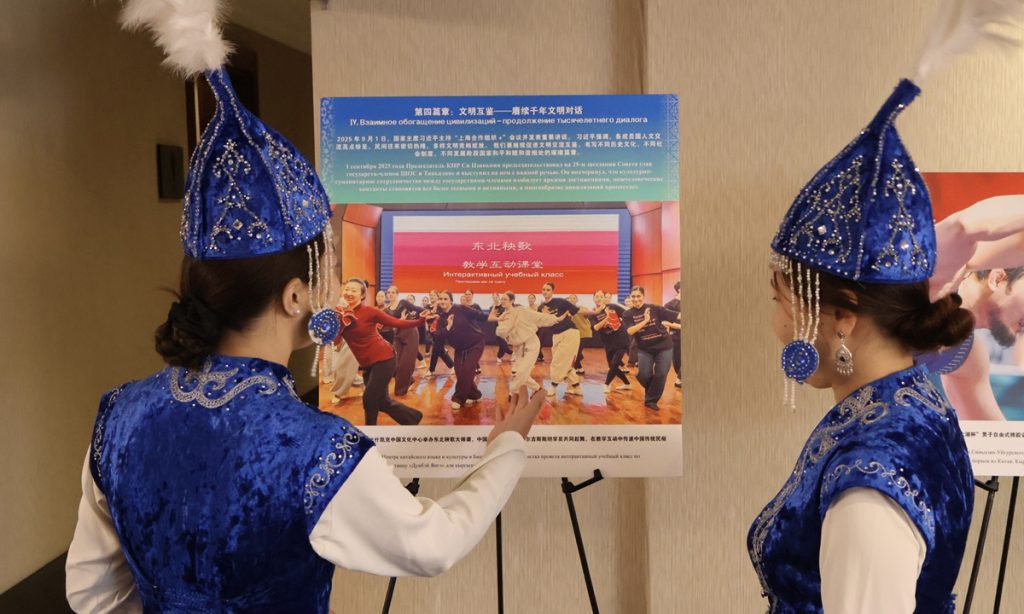
The Global Times "Overseas China Week" event landed in Bishkek, capital of Kyrgyzstan on Wednesday, launching the "Linked by Mountains and Rivers, Bound by Shared Hearts - China and Kyrgyzstan Hand-in-Hand for the Future" photo exhibition, during the 2026 China-Kyrgyzstan Media Cooperation Forum.
Attendees included Cui Shixin, Deputy Editor-in-Chief of the People's Daily; Salkyn Sarnogoeva, Deputy Minister of Culture, Information, Sports and Youth Policy of the Kyrgyz Republic; Galina Baitekerek, head of Kyrgyz Tuusu Publishing House in Kyrgyzstan; and Sun Dapeng, counselor of the Chinese Embassy in Kyrgyzstan. Many representatives from mainstream media, academic experts and business leaders of both countries also visited the exhibition.
At the 25th Meeting of the Council of Heads of State of the Shanghai Cooperation Organization (SCO), Chinese President Xi Jinping chaired the meeting and delivered a speech titled "Staying True to SCO Founding Mission And Ushering in a Better Future" in Tianjin, North China, on September 1, 2025. "Looking ahead, we should carry forward the Shanghai Spirit in a world fraught with challenges and changes, forge ahead with solid steps, and better tap into the potential of our Organization," he said in the speech.
This year marks the 25th anniversary of the founding of the SCO. Over the past quarter-century, it has been the world's largest regional international organization by both geographical area and population. As good neighbors, good friends and good partners enjoying close people-to-people ties, China and Kyrgyzstan continue to align their development strategies and expand pragmatic cooperation under the SCO framework. Against this backdrop, the Global Times held the "Overseas China Week" event in Bishkek. The photo exhibition centered on four themes: "shared security responsibilities," "integrated development opportunities," "joint ecological construction," and " mutual learning among civilizations." It presented solid efforts by China and other SCO member states including Kyrgyzstan to uphold multilateralism and building a community with a shared future for humanity, striking a chord with local visitors.
At the "shared security responsibilities" section, Cholponai Turdakunova, an editor of Silk Road: Cultural Development, told the Global Times that she was deeply impressed by photos of joint counter-terrorism drills among SCO members. Under the SCO framework, China and Central Asian countries have deepened practical security cooperation with fruitful outcomes in joint counter-terrorism and safeguarding border stability. The photos allowed visitors to directly feel the SCO's efforts to safeguarding peace and stability.
Extending from security to development, China-Kyrgyzstan cooperation has delivered tangible benefits to people's daily lives. In the "joint ecological construction" section, a photo of Bishkek's waste-to-energy project resonated strongly with local visitors. Rysbekova Aishoola Rysbekovna, a Chinese language teacher at the Kyrgyz National University, shared her experience with the Global Times, saying that she had paid a visit to the city's first waste incineration power plant invested and built by a Chinese enterprise. She observed that since the two countries promoted the construction of waste treatment facilities last year, local environmental sanitation has improved notably, ecological governance has yielded steady results, and the concept of green development has gradually taken root among local residents.
"China and Kyrgyzstan have numerous common grounds and connections for deeper cooperation," said Rysbekova Aishoola Rysbekovna. Current bilateral cooperation spans economy, politics, environmental protection and people-to-people exchanges. Bilateral ties are growing closer and moving steadily forward. "I hope the two countries can engage more frequently and achieve more win-win results in the future."
The "integrated development opportunities" section illustrated deepening connectivity, featuring images from the SCO Countries Worker Skills Contest and the China-Kyrgyzstan-Uzbekistan railway. Meanwhile, the "mutual learning among civilizations" section captured people-to-people bonds - from cultural performances to booming tourism. Elena Zholobova, Editor-in-Chief of Kyrgyz newspaper Slovo Kyrgyzstana, told Global Times reporters after visiting the exhibition that the event was vivid and lively, with information and visual displays complementing each other. She noted that the media industry is now swept by a digital wave, and many media outlets struggle to balance quality content with appealing visuals. By contrast, this exhibition is both visually engaging and thought-provoking, and demonstrates outstanding professionalism in information organization and visual presentation.
In addition to the photo exhibition, this "Overseas China Week" event also presented the Russian-language edition of the Volume IV of the book series Xi Jinping: The Governance of China, displayed a series of Global Times feature reports on the Chinese president's important thoughts, including the special series "Decoding the Book Xi Jinping: The Governance of China," as well as reports on the practical achievements of cooperation under the framework of the SCO and the tangible progress made in building the China-Kyrgyzstan comprehensive strategic partnership in the new era. Custom cultural and creative products at the exhibition were also well received by visitors. Among them, LLVision AR translation glasses attracted crowds of local residents who stopped to try them on. Many Kyrgyz guests said they expect smart technology to further break down language barriers for China-Kyrgyzstan people-to-people exchanges, economic and trade cooperation, and media dialogue. While technology facilitates communication, sincere messages in the visitor book were equally touching. Visitors wrote heartfelt notes such as "Long live China-Kyrgyzstan friendship" and "Smooth cooperation between China and Kyrgyzstan." Some left their names with the message "We are here to witness," expressing joy at witnessing the friendly exchanges between the two countries.
Prior to the Bishkek event, the Global Times' "Overseas China Week" has been held in South Africa, South Korea, Brazil, Argentina, Germany, Kazakhstan and other countries. Using photography as a medium, it shares China's development stories with the world, conveys China's openness, and builds a bridge for closer people-to-people ties between China and global communities.
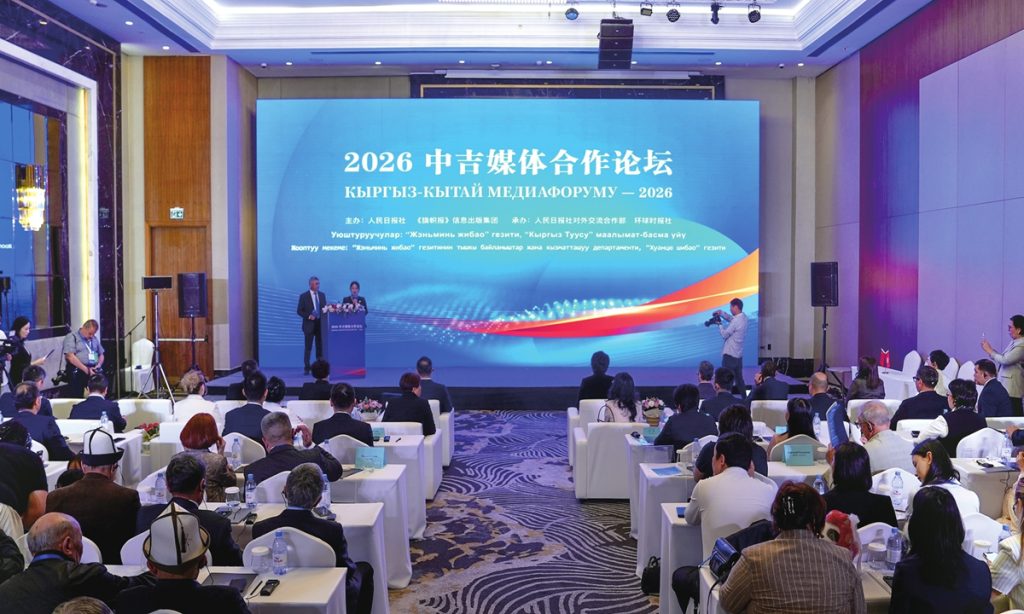
The 2026 China-Kyrgyzstan Media Cooperation Forum was held in Bishkek, Kyrgyzstan, on Wednesday, under the theme "Deepening China-Kyrgyzstan Media Cooperation for a Brighter SCO Future." Nearly 100 participants, including media representatives, government officials, experts, scholars and business leaders from both countries attended the event to engage in in-depth exchanges and discussions on topics including economic and trade development, cultural exchanges and media cooperation.
Attendees noted that ties between China and Kyrgyzstan have continuously enriched and deepened in the new era. They emphasized that media organizations from both nations should shoulder their responsibilities, build consensus on shared values, reflect the shared aspirations of both peoples for a better life, and work together to tell the stories of China-Kyrgyzstan good-neighborliness, friendship and mutually beneficial cooperation.
This year marks the 25th anniversary of the founding of the Shanghai Cooperation Organization (SCO). Participants of the 2026 China-Kyrgyzstan Media Cooperation Forum believe that by upholding the Shanghai Spirit of mutual trust, mutual benefit, equality, consultation, respect for diversity of civilizations and pursuit of common development, the organization has maintained a strong momentum of growth. They believe that the media of SCO member states should fully leverage their role as bridges and bonds, promote the Shanghai Spirit, strengthen pragmatic cooperation and enhance people-to-people connectivity, thereby contributing wisdom and strength to building a more beautiful SCO home.
Cui Shixin, Deputy Editor-in-Chief of the People's Daily, said in his opening address that the next Meeting of Council of Heads of State of SCO will be held in Bishkek in the second half of 2026. Linked by mountains and rivers, China and Kyrgyzstan are good neighbors, good friends and good partners enjoying close people-to-people ties. At this pivotal moment, holding the China-Kyrgyzstan Media Cooperation Forum to explore the responsibilities and missions of the two countries' media in the new era is well-timed and of profound significance. This not only puts into practice the important consensus reached between President Xi Jinping and President Sadyr Japarov on deepening the China-Kyrgyzstan comprehensive strategic partnership for a new era, but also constitutes a concrete action to foster a favorable public opinion environment and consolidate a solid popular foundation for the upcoming SCO Bishkek Summit.
He put forward four proposals: Media of both countries should build consensus on development to anchor mutual trust, boost mutually beneficial cooperation to pave the way for prosperity, deepen cultural exchanges to nurture the tree of friendship and consolidate institutional foundations to amplify the voice of the SCO.
Salkyn Sarnogoeva, Deputy Minister of Culture, Information, Sports and Youth Policy of the Kyrgyz Republic, noted in her speech that integration within the framework of the SCO is not merely about economic projects and political agreements. Above all, it represents the convergence of cultures and human stories. It is media practitioners who translate the sophisticated language of traditional diplomacy into a narrative of friendship, cooperation and constructive development understandable to all citizens. The SCO is currently in a phase of robust development, with the media sector playing a pivotal strategic role.
"It is the media colleagues present here today who have built a 'cultural bridge' between our two peoples, shaping a shared information space and laying the foundation for trust and mutual understanding," she said.
Galina Baitekerek, head of Kyrgyz Tuusu Publishing House in Kyrgyzstan, mentioned in her address that the ancient Silk Road, generations of good-neighborliness and friendship and a shared aspiration for regional peace and development have tightly bound Kyrgyzstan and China together. Against this backdrop, strengthening cooperation in the information field is of paramount importance.
Baitekerek said that Chinese and Kyrgyz media sectors enjoy broad prospects for cooperation in various fields, including exchanging experience among journalists and experts, launching joint media initiatives, advancing digital platforms and new media development, and scaling up support for young journalists. "I am confident that deepening collaboration among journalists, experts and media organizations from both countries will surely make significant contributions to the cultural and people-to-people development of the SCO," she remarked.
Sun Dapeng, counselor of the Chinese Embassy in Kyrgyzstan, said in his speech that media plays an irreplaceable role in deepening mutually beneficial cooperation and enhancing people-to-people bonds. Media cooperation also stands as a key priority for cooperation within the SCO and between China and Kyrgyzstan. The forum is another major achievement of media cooperation between the two countries. The deeper the media exchanges, the closer the hearts of the two peoples, and the further journalists travel, the wider the stories of China-Kyrgyzstan friendship will spread, he said.
China is willing to join hands with Kyrgyzstan to firmly promote the Shanghai Spirit, continuously deepen media cooperation, and make greater contributions to building a closer SCO community with a shared future and a China-Kyrgyzstan community with a shared future, the Chinese diplomat noted.
Elena Zholobova, Editor-in-Chief of Kyrgyz newspaper Slovo Kyrgyzstana, told Global Times reporters that the China-Kyrgyzstan Media Cooperation Forum is a high-quality exchange platform with immense potential, which is vital for media outlets aiming to go international and engage in mutual communication.
"Currently, cultural exchanges and economic interactions between China and Kyrgyzstan are becoming increasingly vibrant. By leveraging the rich news resources of the SCO, both our two countries can better identify convergence points to jointly create high-quality content that caters to the interests of readers in both countries," she said.
People-to-people connectivity is the solid foundation of bilateral cooperation, while people-to-people exchanges serve as the most vibrant foundation of China-Kyrgyzstan good-neighborliness and friendship. Du Hua, Director of the Confucius Institute on the Chinese side at Bishkek State University, shared her first-hand observations from years of working in Kyrgyzstan during an interview with the Global Times.
Du noted that local youth are increasingly drawn to the Chinese language and culture, reflecting a deep-rooted and solid foundation of public goodwill between China and Kyrgyzstan. She suggested that media from both countries should embrace a diverse narrative approach focused on "localization and everyday life," digging deep into the personal stories of ordinary people to serve as a bond that genuinely enhances mutual understanding and emotional connection between the two peoples.
As a bridge connecting the world, aviation serves as a bond deepening the friendship between China and Kyrgyzstan. In a speech, a representative from Air China's sales office in Bishkek announced that Air China will officially enter the Kyrgyz market. Earlier media reports indicated that Air China will launch a direct flight between Beijing and Bishkek starting July 17, 2026.
With the launch of this route, two-way passenger traffic between China and Kyrgyzstan is expected to exceed 200,000 for the first time in 2026, paving a smoother Air Silk Road for people-to-people exchanges and economic and trade cooperation between the two countries.
Eduard Kubatov, Director of the State Agency for Tourism Development of Kyrgyzstan, told the Global Times that the prospects for China-Kyrgyzstan tourism cooperation are highly promising. The steady growth in tourist numbers fully demonstrates the immense potential of bilateral cultural and tourism cooperation, and the launch of Air China's direct flight route is anticipated to inject a powerful boost into the tourism sector, he said. Currently, the Kyrgyz side is continuously aligning with the Chinese side to jointly tap into new opportunities for cultural and tourism cooperation, Kubatov noted.
Currently, China-Kyrgyzstan cooperation is continuously expanding its scope, accelerating the shift to new fields, including the digital economy and artificial intelligence (AI). In his remarks at the forum, Li Dahai, CEO of Chinese AI company ModelBest, said that Central Asia is not only a geographical hub but can also become a smart hub on the Digital Silk Road in the new era. We look forward to working with Kyrgyzstan and other Central Asian countries to ensure that AI better understands local languages, aligns more closely with local industries, and serves the local people more effectively, Li said.
The forum was co-hosted by the People's Daily and Kyrgyz Tuusu Publishing House. The event featured keynote speeches and roundtable dialogues, alongside the "Linked by Mountains and Rivers, Bound by Shared Hearts - China and Kyrgyzstan Hand-in-Hand for the Future Photo Exhibition" and the Kyrgyzstan stop of the Global Times "Overseas China Week" event. During the forum, the People's Daily signed a memorandum of understanding on cooperation with Kyrgyz Tuusu Publishing House, and the Global Times signed a cooperation agreement with Slovo Kyrgyzstana.
At the forum venue, the Secretariat of the Belt and Road News Network (BRNN) and the Global Times jointly released a report on interest trends among youth in SCO member states. The report points out that youth in these countries generally endorse the concepts and actions of the SCO, highly appreciate its positive role in global governance, and hold high expectations to deepening cooperation across various fields among member states.
China appreciates Uruguay's adherence to the one-China principle and will support the country in safeguarding its own sovereignty, security and development interests, Chinese Foreign Minister Wang Yi said Thursday.
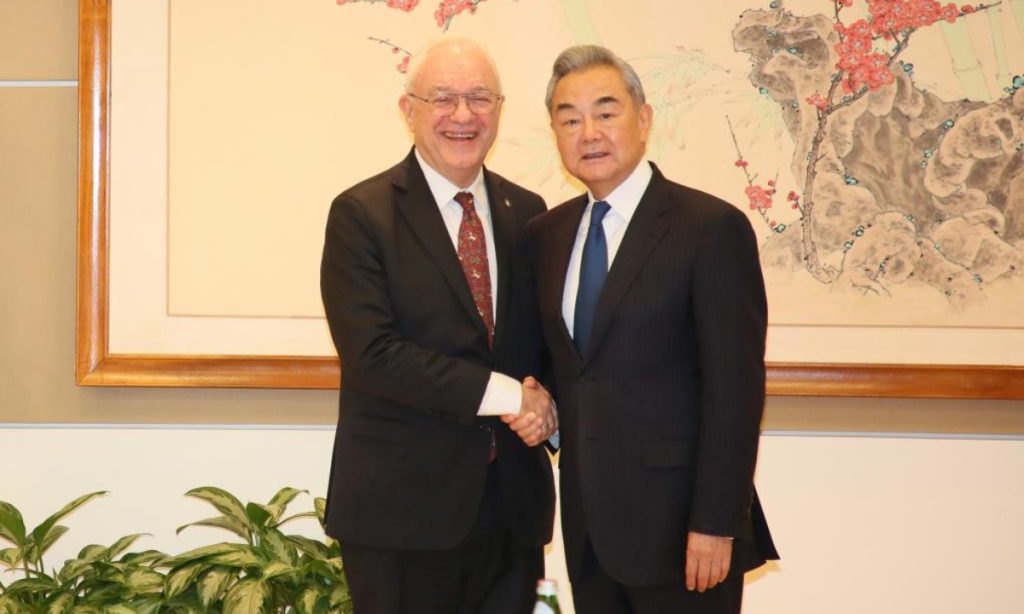
Meeting with Uruguay's Foreign Affairs Minister Mario Lubetkin in New York, Wang, also a member of the Political Bureau of the Communist Party of China Central Committee, said that maturity, stability and predictability have been the defining features of China-Uruguay relations since the two countries established diplomatic ties.
China is ready to work with Uruguay to well implement the consensus reached by the two heads of state, intensify high-level exchanges, deepen cooperation across all fields and elevate the China-Uruguay comprehensive strategic partnership to a new height, he said.
Noting that Uruguay is the current rotating chair of the Group of 77 and China, Wang said China stands ready to strengthen multilateral coordination with Uruguay to promote an equal and orderly multipolar world and universally beneficial and inclusive economic globalization.
Lubetkin said Uruguay is ready to work with China and leverage its role as the rotating chair of the Group of 77 and China to advance the reform agenda of the United Nations.
He said Uruguay firmly adheres to the one-China policy and is ready to work with China to strengthen high-level exchanges and expand cooperation in fields such as trade, finance, energy, cultural and people-to-people exchanges, as well as science and technology, to continuously advance bilateral comprehensive strategic partnership.
Today, China-Uzbekistan all-weather comprehensive strategic partnership for a new era has reached an unprecedentedly high level, accompanied by an expansion of practical cooperation. One dimension of mutually beneficial ties is interregional cooperation.
The Third Uzbek-Chinese Interregional Forum, which is taking place from May 20 to 22 in the historic city of Xi'an, Northwest China's Shaanxi Province, will undoubtedly become another important milestone in deepening cooperation between the regions of our countries.
The ties between the regions of Uzbekistan and China stretch back centuries, forming a unique historical foundation. The ancient cities of Uzbekistan and China were connected by trade, culture, science, and people-to-people contacts. The ancient Silk Road not only facilitated economic prosperity but also served as a space for the exchange of ideas, technologies, knowledge, and cultural traditions.
In recent years, under the strategic guidance of the heads of state, relations between the two countries have acquired a qualitatively new dimension and our cooperation has entered a "golden period of development."
The close relations between the two heads of state serve as a strong foundation and the most important factor in bilateral cooperation. Regular meetings between the heads of state, a high level of political trust, and alignment of views on a wide range of international and regional issues create favorable conditions for expanding practical interaction across all spheres.
Interregional dialogue is becoming one of the most dynamically developing components of this cooperation.
In January 2024, the First Uzbek-Chinese Interregional Forum was held in the city of Urumqi, marking a new starting point for the development of horizontal ties between the regions of the two countries.
The Second Interregional Forum, held on June 1-2, 2025, in Samarkand, confirmed that regional interaction is gradually turning into one of the key pillars of bilateral partnership. Its scale has grown noticeably. The events were attended by over 2,800 representatives from both countries - from government structures, regional administrations, business circles, educational and scientific institutions. The Third Interregional Forum, which takes place in Xi'an - the ancient capital of China and the historical starting point of the ancient Silk Road - promises to be the next milestone in its development.
From this city, routes connecting China with Samarkand, Bukhara, Fergana, and other ancient centers of our country once began. For centuries, Xi'an served as a meeting place for civilizations, trade, scientific knowledge, and cultural exchange. Undoubtedly, the forum will raise interregional cooperation between Uzbekistan and China to an even higher level, opening new opportunities for implementing joint initiatives, expanding investment partnerships, and further bringing our peoples closer together.
The dynamics of the relationship are also reflected in economic indicators. A significant part of this dynamic is driven by interregional cooperation. Thanks to investments, new production facilities, industrial capacities, logistics centers, and energy infrastructure projects are being created in the regions. Over the past five years, the total volume of mutual trade has increased threefold. Today, there are 5,400 enterprises with Chinese capital operating in our country.
The continuously improving level of connectivity has laid a solid foundation for facilitating in-depth local cooperation between the two countries. Currently, more than 60 flights per week are operated between Uzbekistan and China on more than ten routes. These routes connect not only capitals but also major regional centers, opening additional opportunities for business, tourism, and investment contacts. From Tashkent, Samarkand, and Fergana, passengers can fly directly to Beijing, Shanghai, Xi'an, Guangzhou, Hangzhou, Chengdu, Urumqi, Sanya, and several other Chinese cities. Against this backdrop, the number of mutual tourist visits is growing. In 2025, over 300,000 Chinese tourists visited Uzbekistan, several times more than in the previous year. This is facilitated by the 30-day visa-free policy established between our countries in June 2025.
In general, in current conditions, regions are increasingly becoming points of economic growth, platforms for technology implementation, attracting investment, developing industrial cooperation, and humanitarian exchanges.
Uzbekistan is willing to work with China to give full play to the role of interregional cooperation mechanisms and platforms, promote the implementation of more practical cooperation results, continuously enrich the connotation of the Uzbekistan-China all-weather comprehensive strategic partnership for a new era, and promote the friendly cooperation between the two countries to move forward.
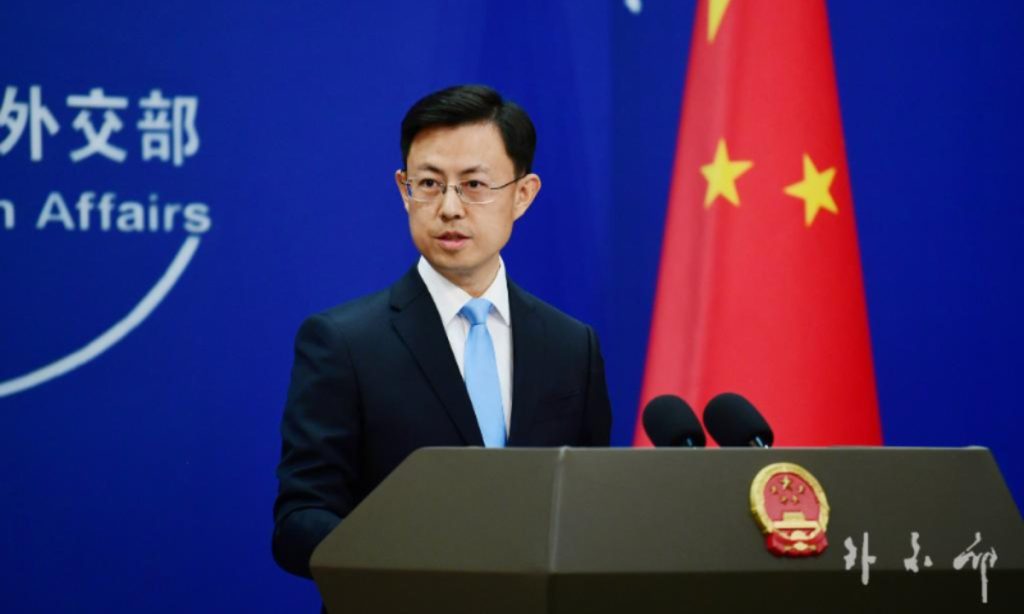
In response to media inquiry over a recent poll showing that more than 80 percent of Chinese and Russian young respondents believe that China-Russia relations are friendly, Chinese Foreign Ministry spokesperson Guo Jiakun said on Tuesday that the survey results reflect the friendly public sentiment between the two countries, particularly the positive willingness of the younger generation to further strengthen exchanges. It also demonstrates the high level of China-Russia relations.
According to media report, the survey was jointly conducted by the Chinese and Russian sides of the Council of Education under the China-Russia Friendship Committee for Peace and Development on the occasion of the launch of the "China-Russia Year of Education". It was carried out from late April to early May 2026 by the Global Opinion Research Center at Renmin University of China and a Russian partner organization, using an online survey of young people aged 18 to 35 in China and Russia.
Released on Friday at Renmin University of China, the findings noted that 87.5 percent of Russian youth and 85.5 percent of Chinese youth view China-Russia relations as friendly.
"Russian President Putin will begin his state visit to China today. We believe that under the strategic guidance of two leaders, the friendship between China and Russia across generations will take deeper root in the hearts of the people," Guo said.
The youth of both countries will also join hands to pool their youthful strength, injecting vitality into the China-Russia comprehensive strategic partnership of coordination for the new era, the spokesperson noted.